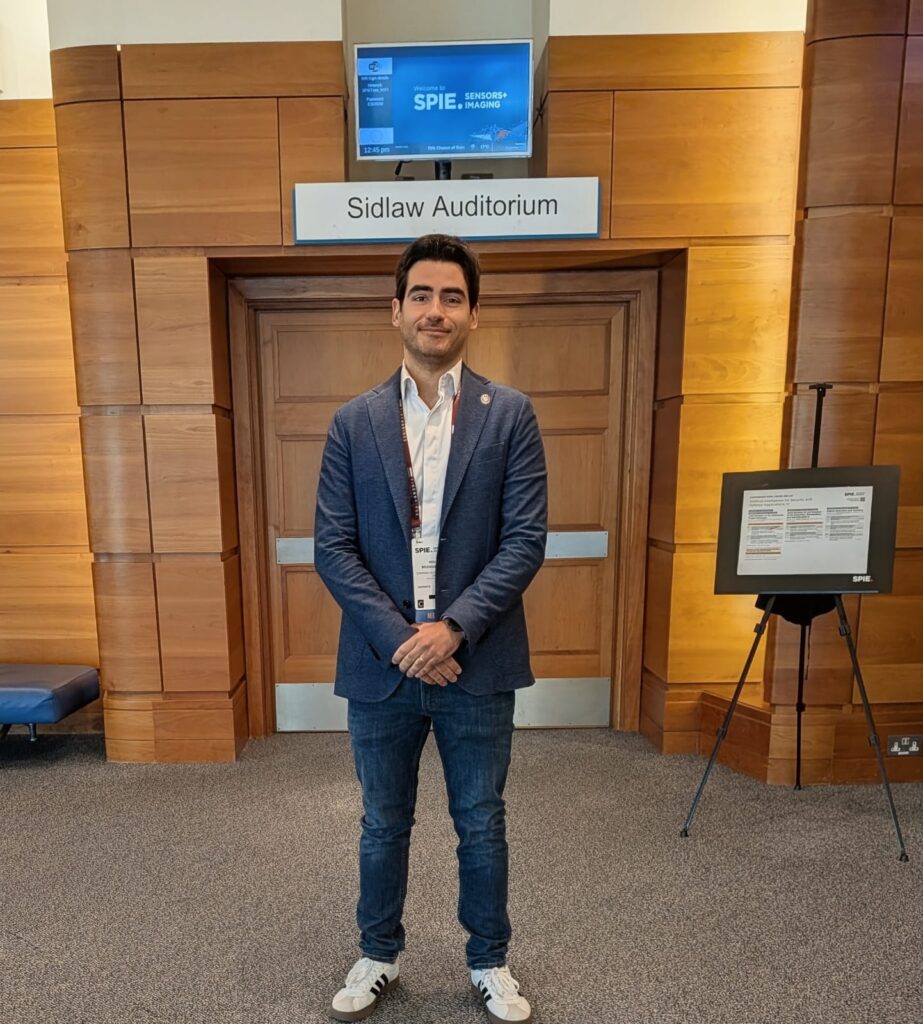
Enhancing maritime domain awareness using latent space representations: SatCen at SPIE Sensors + Imaging 2026
As satellite constellation revisit rates increase, the sheer volume of high-resolution Synthetic Aperture Radar (SAR) imagery creates a significant “data gravity” bottleneck for real-time monitoring. Transferring and processing uncompressed image tiles across distributed cloud architectures or to remote operational nodes causes critical latency in time-sensitive applications like maritime domain awareness (MDA).
To address this challenge, Embed2Scale partner the European Union Satellite Centre (SatCen) presented new research at SPIE Sensors + Imaging 2026 in Edinburgh, Scotland. Dr. Miguel A. Belenguer-Plomer showcased how compressing Sentinel-1 Ground Range Detected (GRD) imagery into low-dimensional latent-space representations using IBM and ESA’s TerraMind geospatial foundation model drastically reduces data transmission requirements while retaining critical analytical utility. Instead of processing original multi-gigabyte SAR rasters, the approach applies linear and non-linear probing directly to fixed-size vector embeddings.
Key results across key operational maritime tasks
The approach has demonstrated strong benchmark capabilities:
- Vessel Detection: Achieved a receiver operating characteristic area under curve (ROC-AUC) score of 0.95, proving that compressed vectors retain essential feature signatures for discriminating vessels from ocean background.
- Vessel Localization: Yielded a median positioning error of approximately 300 meters for vessels exceeding 100 meters in length.
- Vessel Classification: Attained 62% accuracy for majority AIS type-code classification, establishing a clear correlation between compressed embedding attributes and physical vessel length.
While these results confirm the immense potential of Geospatial Foundation Models (GeoFMs) to bypass data transmission bottlenecks, they also highlight current operational boundaries when deploying foundation models for fine-grained maritime security and surveillance in real-world scenarios.
By demonstrating that compressed latent spaces can reliably support downstream linear probing for vessel detection, localization, and classification, SatCen’s work reinforces Embed2Scale’s core mission: enabling scalable, resource-efficient Earth Observation workflows for critical security and monitoring applications.