
Foundation Models Meet Earth Observation: Embed2Scale at Max Planck Institute for Biogeochemistry
Embed2Scale partner Dr. Conrad M. Albrecht (University of Oxford) recently presented a colloquium titled “Self-Supervised Learning for Spectral Remote Sensing: Opportunities and Limitations” at the Max Planck Institute for Biogeochemistry.
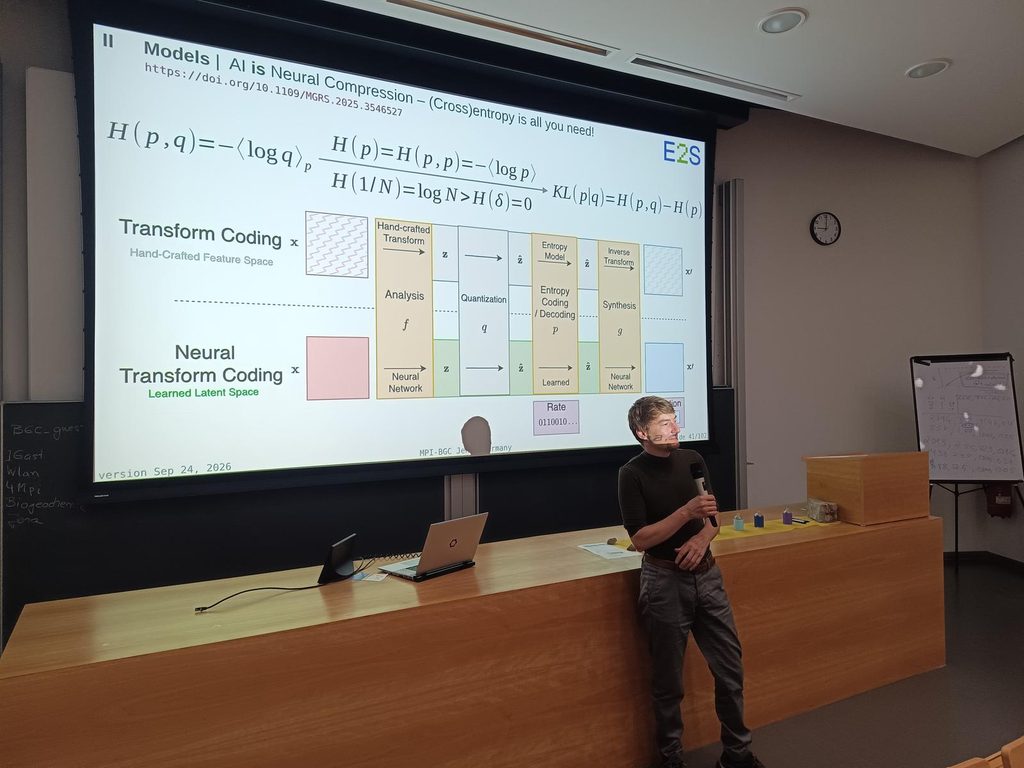
The talk addressed how the rapid emergence of AI “Foundation Models” is reshaping the remote sensing landscape. With specialized hyperspectral satellite missions (such as DLR’s EnMAP, Italy’s PRISMA, and NASA’s EMIT) delivering massive spatial-spectral data cubes, traditional processing methods struggle to keep pace. Within the Embed2Scale framework, self-supervised learning serves as a core engine to train large-scale deep neural networks. These models operate as efficient data compressors, distilling high-dimensional spatio-temporal Earth observation streams into compact, semantically informed embeddings designed for a broad spectrum of downstream scientific tasks.
During the seminar and subsequent research day, Conrad evaluated the distinct value of hyperspectral data—both on its own and in fusion with multi-spectral mainstays like EU Sentinel-2 and US Landsat-8. The discussion highlighted practical applications ranging from fine-grained land cover classification and mineral mapping to tree species identification and trace gas detection. By balancing technical potential with real-world implementation challenges, the session sparked lively debate among MPI-BGC researchers on the concrete opportunities and current limitations of E2S compression models for Earth system modeling.